
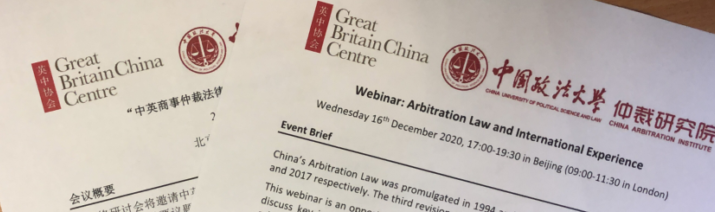
In December 2020, GBCC held two webinars with the China Arbitration Institute (CAI) at China University of Political Science and Law on the ongoing revision of China’s arbitration law.
This was an opportunity to bring together Chinese, UK and international expertise to discuss key issues being considered in the revision, particularly in relation to the scope of the law and ad hoc and institutional arbitration. CAI have been commissioned to undertake research in relation to the revision with the Chinese Ministry of Justice, a key GBCC partner.
The revision is an opportunity to support the adoption of international standards in commercial dispute resolution, key for both China’s legal system and for UK commercial interests in and relating to China.
William Godwin QC, GBCC board member and Counsel at international law firm Arnold & Porter and Professor DU Xinli, Director of the CUPL China Arbitration Institute opened the discussions, which focused on arbitrability and ad hoc and institutional arbitration in relation to Chinese and international arbitration regimes. We were joined for the discussions by the Director of the Arbitration Division in the Chinese Ministry of Justice, an institution that GBCC has been working with on arbitration reform and liberalisation since 2018. The second webinar focused on the power of tribunals, arbitral procedure and the dual track system of domestic and international arbitration.
Across the two webinars, we were kindly joined by many practitioner and scholarly experts, including Adrian Hughes QC (39 Essex Chambers) and Steven Thompson QC (XXIV Old Buildings and Bar Council International Committee Chair), both from the Bar Council of England and Wales’ China Interest Group; Professor Yarik Kryvoi, Senior Research Fellow at the British Institute of International and Comparative Law; Professor JIANG Lili and Dr XUE Tong, respectively Secretary-General and Deputy General Secretary of the CAI; Dr Fu Panfeng, Assistant Professor, CASS Institute of Law; Professor CHEN Li, Vice Dean and Professor of International Law, Fudan Law School; Kathryn Sanger and Helen Tang, Partners at Herbert Smith Freehills, and Ye Weina, HSF Kewei Law Firm (Shanghai); Susan Finder, Distinguished Scholar in Residence, School of Transnational Law at Peking University (Shenzhen); Dr Mimi ZOU, Associate Professor in Law at the University of Reading and co-founder of the Oxford Deep Tech Dispute Resolution Lab and Professor Matthew Erie, Associate Professor of Modern Chinese Studies, University of Oxford; Charles Wang, Partner, Rosenblatt; and Dr WANG Haifeng, Law Professor and the Director of International Law Department of Law Institute.
We very much appreciate their insightful and thoughtful contributions to the discussions and look forward to continued cooperation and sharing of best practice in 2021.